


ARKK Stock :Updated April 2026BATS: ARKK~$68.29 / shareAUM: $6.33BExpense Ratio: 0.75%
Introduction
Few ETFs in the modern investing landscape ignite as much passion — and debate — as the ARK Innovation ETF (ARKK). Managed by the visionary and often polarizing Cathie Wood, ARKK has become a proxy for growth investing at its most audacious: high conviction, high volatility, and high stakes. It is the flagship fund of ARK Invest, and its fortunes are watched by retail and institutional investors alike.
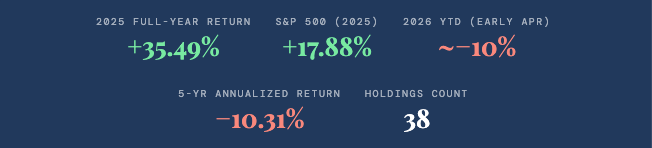
In 2026, ARKK is firmly back in the spotlight. After a remarkable 35.49% return in 2025 that more than doubled the S&P 500’s gain, the fund stumbled into the new year, giving back ground amid a broad repricing of growth stocks. This creates one of the most interesting entry-point questions in years: is ARKK poised for another run, or is the recent dip a warning sign?
This comprehensive analysis breaks down what ARKK is, how it has performed, the forces shaping it in 2026, and whether it belongs in your portfolio.
What Is ARKK?
The ARK Innovation ETF is an actively managed exchange-traded fund launched on October 31, 2014, by ARK Invest under the leadership of CEO Catherine Wood. Unlike passive ETFs that simply track an index, ARKK’s portfolio is shaped by the high-conviction views of Wood and her research team, who seek companies driving “disruptive innovation” — defined as technologically enabled products or services that could fundamentally change how the world works.
The fund must invest at least 65% of its assets in companies relevant to this innovation theme, spanning both domestic and foreign equity markets. ARK targets five core innovation platforms: artificial intelligence, DNA sequencing, robotics and automation, energy storage, and blockchain technology.
ARKK Holdings Overview
As of early 2026, ARKK holds 38 positions, with the top 10 accounting for roughly 51.9% of the fund and the top 25 representing a concentrated 84.59% of assets. This concentration means a handful of companies have an outsized influence on returns. Healthcare leads sector exposure at around 30%, followed by technology at 25% and financial services at 14%, reflecting the convergence of biotech platforms with digital innovation.
Top Holdings
| Company | Ticker | Approx. Weight | Sector |
|---|---|---|---|
| Tesla | TSLA | ~11.1% | Consumer Discretionary / EV |
| CRISPR Therapeutics | CRSP | ~6.9% | Genomics / Biotech |
| Tempus AI | TEM | ~5.2% | AI / Healthcare |
| Coinbase | COIN | ~3.6% | Fintech / Crypto |
| Palantir | PLTR | ~3.2% | AI / Data Analytics |
| Robinhood Markets | HOOD | ~3.0% | Fintech |
| Roku | ROKU | ~2.8% | Streaming / Technology |
| Roblox | RBLX | ~2.5% | Gaming / Metaverse |
| Beam Therapeutics | BEAM | ~2.1% | Gene Editing |
| UiPath | PATH | ~1.9% | Robotics / Automation |
How ARKK Compares to Other ETFs
Unlike passive technology ETFs such as QQQ or VGT, ARKK is an actively managed, non-diversified fund. Its portfolio is deliberately concentrated and frequently rebalanced — annual turnover often exceeds 80% — giving it a very different risk profile. It targets earlier-stage innovation companies with exponential growth potential over a five-year horizon, rather than the established mega-caps that dominate index-based funds.
Historical Performance of ARKK Stock
ARKK’s track record is one of the most dramatic in ETF history — marked by extraordinary peaks and punishing valleys. Understanding this history is essential before forming any view on its future.
Key Performance Events
- 2014 — LAUNCH
Fund Inception
ARKK launched in October 2014 at a modest size, with Wood’s disruptive innovation thesis as its guiding philosophy.
- 2020 — THE BREAKOUT
+152.8% — A Star Is Born
Pandemic-era stimulus, zero interest rates, and a surge in stay-at-home tech spending supercharged ARKK’s high-growth holdings. The fund became a cultural phenomenon. Wood’s fame soared.
- 2021 (PEAK)
All-Time High Near $160/share
ARKK briefly neared its all-time high as speculative momentum peaked. This level has not been revisited.
- 2022 — THE CRASH
−67% — Rising Rates Devastate Growth
The Federal Reserve’s aggressive rate-hiking cycle crushed long-duration growth stocks. ARKK shed more than two thirds of its value — its maximum drawdown since inception eventually reaching −80.97%.
- 2023 — PARTIAL RECOVERY
+67.64% — AI Optimism Returns
The AI boom and broader growth stock recovery drove a strong rebound, though ARKK remained far below its all-time highs.
- 2025 — OUTPERFORMANCE
+35.49% — Beats the Market
A standout year for the fund, driven by Robinhood (+204%), strong AI momentum in Palantir, and broad innovation sector tailwinds.
- 2026 YTD — PULLBACK
~−10% — Growth Repricing
After an exceptional 2025 run, weakness in Tesla and Coinbase has weighed on the fund in the early months of 2026.
Annual Returns Snapshot
| Year | ARKK Return | S&P 500 Return | Notes |
|---|---|---|---|
| 2020 | +152.8% | +18.4% | Pandemic tech boom |
| 2022 | −67% | −18.1% | Fed rate hike cycle |
| 2023 | +67.6% | +26.3% | AI recovery rally |
| 2025 | +35.5% | +17.9% | Innovation leaders surge |
| 2026 YTD | ~−10% | ~−4% | Growth stock repricing |
| 5-Yr Annualized | −10.31% | +14.66% | As of Jan 2026 |
“Wood’s style brings sweet wins in rising markets but also painful losses in bearish ones. The fund’s five-year annualized return stands at −10.31% while the S&P 500 returned +14.66% over the same period.”
— TheStreet, January 2026
Factors Affecting ARKK Stock in 2026
Several macro and micro forces are shaping ARKK’s trajectory in 2026, pulling in both directions.
Technology & AI Trends
The continued diffusion of artificial intelligence into biotech, robotics, and enterprise software represents ARKK’s most powerful structural tailwind. Wood and ARK Invest argue that AI is enabling productivity gains that will accelerate revenue growth across all five of their innovation platforms. The fund’s recent purchase of OpenAI shares signals continued conviction in frontier AI.
Interest Rates & Federal Policy
ARKK is acutely sensitive to interest rate expectations because its holdings are “long-duration” growth stocks — their valuations depend heavily on discounting future earnings. Wood’s 2026 outlook forecasts that inflation will continue to decelerate and that the Federal Reserve will pursue further rate cuts, which would be a meaningful tailwind for the fund. However, any upside surprises in inflation could quickly reverse this dynamic.
Cathie Wood’s Investment Strategy
Wood remains committed to her five-year innovation thesis and high-conviction, concentrated approach. She views 2026 as a year when the U.S. economy, which she describes as a “coiled spring,” could bounce back powerfully. She expects deregulation and fiscal stimulus to turbocharge innovation-sector GDP growth in the second half of 2026. Separately, the fund has begun adding exposure to OpenAI as its valuation grows.
Investor Sentiment & Social Media
ARKK remains a highly sentiment-driven fund. Its transparent daily holdings disclosure means retail investors can track every trade, amplifying momentum swings in both directions. Analysts on Seeking Alpha have noted the fund’s persistent net outflows over the past three years — nearly $1.19 billion over the past year — suggesting that retail enthusiasm has cooled despite the 2025 performance.
Pros and Cons of Investing in ARKK
✓ Pros
- Concentrated exposure to genuinely transformative technologies — AI, genomics, robotics, fintech, blockchain
- Potential for outsized returns in bull markets (see: 2020 and 2023)
- Active management allows tactical repositioning as the innovation landscape evolves
- Full daily holdings transparency is rare and empowers informed investors
- AUM of $6.33B means institutional-grade liquidity and tight bid-ask spreads
✕ Cons
- Extreme volatility — a maximum drawdown of −80.97% since inception is stomach-churning
- High concentration: top 10 holdings are ~52% of the fund, Tesla alone is ~11%
- Underperformance risk — 5-year annualized return of −10.31% vs. S&P 500’s +14.66%
- 0.75% expense ratio is significantly higher than passive competitors (VGT: 0.10%, QQQ: 0.20%)
- High annual turnover (~80%+) creates tax drag in taxable accounts
- Persistent outflows suggest flagging long-term institutional confidence
ARKK vs. Competitors
To make an informed decision, ARKK must be evaluated against the natural alternatives for growth-focused investors.
| ETF | Type | Expense Ratio | 10-Yr Ann. Return | Volatility | Best For |
|---|---|---|---|---|---|
| ARKK | Active | 0.75% | 16.79% | 12.45% | Pure innovation conviction |
| QQQ | Passive | 0.20% | 19.33% | ~5% | Nasdaq-100 broad exposure incl. Mag 7 |
| VGT | Passive | 0.10% | 23.18% | 7.85% | Core tech infrastructure (semis, software) |
The comparison is humbling for ARKK over the long run. VGT and QQQ have delivered superior risk-adjusted returns with a fraction of the volatility and at a much lower cost. ARKK’s Sharpe Ratio of 0.11 is dramatically lower than VGT’s 0.53, meaning investors in ARKK are being compensated poorly for the risk they’re taking on. What ARKK uniquely offers is pure exposure to pre-commercial innovation — companies that are not yet profitable but could be transformational. VGT and QQQ, by contrast, skew toward large, profitable technology companies. If you believe the next wave of value creation will come from genomics, AI-native companies, and energy storage rather than cloud megacaps, ARKK is the more targeted bet.
Expert Opinions & Analyst Ratings
Analyst sentiment on ARKK in 2026 is sharply divided, reflecting the fund’s inherent polarizing nature.
“Despite sustained real GDP growth during the past three years, the underlying U.S. economy has suffered a rolling recession and has evolved into a coiled spring that could bounce back powerfully during the next few years.”— Cathie Wood, ARK Invest 2026 Outlook Letter, January 15, 2026
Wood remains bullish, anticipating that deregulation, declining inflation, and AI productivity gains will create a powerful tailwind for innovation-focused companies in the second half of 2026. She views Bitcoin and blockchain as important portfolio diversifiers and has been buying into AI frontier companies including OpenAI.
Skeptics, however, are not hard to find. Seeking Alpha analysts have maintained a “Sell” rating on ARKK, citing the fund’s high portfolio turnover (43–80%), concentrated bets in Tesla and crypto, and near-term macro risks. Morningstar previously labelled the ARK fund family a “value destroyer,” estimating that ARK funds eliminated roughly $14.30 billion in shareholder value between 2014 and 2024 — largely because many investors bought near the peak in 2020–2021 and held through the collapse. Technical indicators as of early April 2026 show mixed signals: the RSI oscillator exited oversold territory on March 31, suggesting potential for a near-term bounce, while the Aroon Indicator entered a downward trend on April 2, 2026.
How to Invest in ARKK
Choose a Brokerage
ARKK trades on the BATS exchange like any stock. It is available commission-free on platforms like Fidelity, Schwab, TD Ameritrade, Robinhood, and Interactive Brokers. Fidelity’s Active Trader Pro is a strong choice for research-oriented investors.
Determine Your Position Size
There is no minimum investment beyond the cost of a single share (around $68 as of early April 2026). Fractional shares are available on most platforms. Given ARKK’s volatility, most advisors suggest limiting it to a small satellite position (5–15%) rather than a core holding.
Consider Dollar-Cost Averaging
Given ARKK’s extreme price swings, investing a fixed dollar amount regularly (DCA) reduces the risk of buying at a peak and allows you to accumulate more shares during downturns.
Understand Tax Implications
ARKK’s high annual turnover generates frequent capital gains distributions, making it less tax-efficient than passive ETFs. Holding ARKK in a tax-advantaged account (IRA, 401k) is preferable to a taxable brokerage account where possible.
Set a Long-Term Horizon
ARK Invest explicitly designs its portfolios for a five-year investment horizon. Investors who sold during the 2022 bear market locked in severe losses; those who held through 2023 and 2025 saw meaningful recovery. If you invest in ARKK, commit to the thesis — not to the quarterly price action.
Future Outlook
Looking ahead, ARKK’s performance will hinge on the interplay of three major forces: macroeconomic conditions, the pace of AI and biotech commercialization, and the trajectory of its largest holdings.
Bullish Scenarios
If the Federal Reserve continues cutting interest rates and inflation decelerates as Wood projects, high-growth stocks would benefit significantly. A sustained AI productivity boom — with ARKK’s biotech and robotics holdings monetizing AI-enabled discoveries — could drive a strong multi-year run. The fund’s genomics thesis is particularly compelling: advances in CRISPR gene editing and precision medicine represent enormous long-term addressable markets. Wood’s target of GDP growth accelerating in the second half of 2026, powered by deregulation and fiscal stimulus, would be a significant catalyst.
Bearish Scenarios
Persistent inflation would force the Fed to pause or reverse rate cuts, directly pressuring ARKK’s long-duration holdings. Tesla’s continuing struggles with autonomous vehicle commercialization, ongoing insider selling in Palantir, and regulatory scrutiny in gene editing and cryptocurrency represent company-level risks. The fund’s structural outflows — nearly $1.19 billion over the past year — could intensify if performance disappoints, creating negative feedback loops. Tariff uncertainty and geopolitical tensions add further macro headwinds.
Sectors to Watch
AI diffusion into biotech and clinical drug discovery, CRISPR therapies reaching commercial milestones, and progress on autonomous driving and energy storage are the key metrics to monitor for ARKK’s holdings. A breakthrough in any of these areas could deliver the kind of multi-bagger returns that made ARKK famous — but the timing remains deeply uncertain.
Conclusion: Is ARKK Worth Investing in 2026?
ARKK is not a fund for the faint-hearted or the short-horizon investor. It is a concentrated, high-conviction bet on the idea that a handful of transformative technologies — AI, genomics, robotics, fintech, blockchain — will reshape the global economy, and that the companies best positioned to capture that value are ones that most investors overlook or misunderstand today.
The case for ARKK is genuine: it delivered a +35.5% return in 2025 in a market that rewarded innovation. Wood’s macro thesis for 2026 — lower rates, deregulation-driven acceleration, AI productivity gains — is coherent and not implausible. And at roughly $68 per share with a $6.33B AUM, the fund is liquid, accessible, and genuinely unique in its exposure.
The case against ARKK is equally real: a 5-year annualized return of −10.31% significantly trails the S&P 500, a 0.75% expense ratio is expensive, and the fund’s −80.97% maximum drawdown is a reminder of how painful these investments can be. For investors who can access the same tech exposure at lower cost and lower volatility through VGT or QQQ, ARKK’s active-management premium may not be worth paying.
The verdict: ARKK fits best as a satellite position — not a core holding — for risk-tolerant, long-horizon investors who genuinely believe in the five-year innovation thesis and can stomach the swings. If you invest, do your research, size it responsibly, and hold for the long run. Never invest money you can’t afford to see decline by 50% before recovering.
📌 Research thoroughly · Monitor ETF trends quarterly · Consult a financial advisor before investing
Top Holdings & 2025 Performance
- HOOD+204%
- PLTR+85%
- CRSPGenomics leader
- TSLAKey risk
- COINVolatile in ’26
- TEMAI + Healthcare
- RBLXMetaverse bet
Key Fund Facts
Inception: October 31, 2014
Manager: Cathie Wood / ARK Invest
Type: Actively Managed ETF
Exchange: BATS
AUM: ~$6.33 billion
Expense Ratio: 0.75%
P/E Ratio: 53.62
Holdings: 38 stocks
Top 10 Concentration: 51.9%
Max Drawdown (all-time): −80.97%
Wood’s 2026 Macro Thesis
ARK Invest’s 2026 outlook envisions the U.S. economy as a “coiled spring,” with deregulation, falling inflation, and AI productivity gains driving GDP acceleration in the second half of the year.
Wood projects further Fed rate cuts, driven by rising unemployment, as a key tailwind for ARKK’s long-duration growth holdings.


