P0 vs P1 incidents are common in IT operations, customer care, and engineering. They help classify a problem’s severity. A P0 (Priority 0) is a system-breaking incident with direct business consequences and no workaround. P1 (Priority 1) is also severe but usually has a workaround and partially affects operations or revenue. Being able to distinguish between P0 and P1 helps teams respond quickly, communicate effectively, and allocate resources appropriately.

When to call it P0:
- Crash of core systems to all users.
- Immediate financial, safety, or compliance risk
- No available workaround
- SLA/SLO breach imminent
When to call it P1:
- Incomplete system degradation of certain users.
- There is workaround, but the efficiency is lower.
- High and not critical impact.
- SLA/SLO not violated at once.
What is a P0?
- Business impact: Critical system failures or outages that halt core business operations. May contain safety hazards or violation of regulations.
- Typical SLA/response expectations: Immediate acknowledgment (minutes), with rapid mitigation and resolution efforts.
- Whom to page: On-call engineers, incident response teams, and high visibility executive leadership.
What is a P1?
- Business impact: High impact incidents whereby the business is affected at the level of primary functions but there is a workaround. May affect revenue or customer experience partially.
- SLA/response requirements: Recognition within hours, more important than P0, but not urgent.
- Roles Involved: Engineering Teams: Engineering teams were engaged in this role, and at times, product managers or stakeholders based on the impact. Support Leads: Support leads were also engaged during this activity.
P0 vs P1 at a Glance (Comparison Table)
| Factor | P0 | P1 |
|---|---|---|
| Priority | Highest | High |
| Severity | Critical | Severe |
| Business impact | Major | Significant |
| User impact | Widespread/critical | Partial or limited |
| Workaround | Usually none | Usually available |
| Response | Immediate | Urgent |
| Example | Entire system is down | Major feature is unavailable |
Examples of thresholds that can be measured.
In order to make the P0 vs P1 classification more objective, take into account measurable thresholds:
- Percentage of affected users: e.g., P0 when more than half of active users are affected, P1 when less than half are affected.
- Error rate: e.g., system error rates above 5% of requests can cause P0, and above 1-5% of requests can cause P1.
- Response Latency: API response time exceeds SLA by more than 200 percent (P0) and 100,200 percent (P1).
- Data loss risk: Any potential permanent data loss—P0; temporary or recoverable loss—P1
- Legal or compliance exposure: Immediate regulatory violation—P0; low-risk compliance issues—P1
Tie-Breaker Rules
With borderline thresholds, other considerations are used to resolve the priority:

- Regulatory deadlines: The immediate deadlines on legal reporting can step a P1 to P0.
- High-performance customers: P0 may be considered as outages of top revenue-generating accounts.
- Closeness to launches or peaks: Failures in the systems just before the launch of products or seasonal peaks might elevate priority.
Real-World Examples (Cross-Function)
Software/SaaS
- P0: Login outage of over 50 percent of users; billing double-charges of invoices.
- P1: Slowness of search; partially malfunctioning dashboard in which there is a workaround.
IT/Infrastructure
- P0: Data center disconnection; ransomware in production identified.
- P1: Single availability zone (AZ) impairment with auto-failover operational
Customer Support/Operations
- P0: Global payment failures at checkout
- P1: delay in processing a refund with a manual resolve.
Escalation and Communication Playbook
On-Call & Paging Matrix
- P0: Immediate paging of on-call engineers, incident manager, and leadership. Continuous monitoring until resolution.
- P1: Primary support or engineering; the leadership informed depending on the impact. Less frequent check-ins than P0.
- Time windowing and rotations: Clarify the overlap of shifts, levels of escalation, and backup cover to eliminate gaps.
Stakeholder Communication
Status page cadence:
- P0 – every 30-60 minutes until resolution
- P1 – every 2-4 hours or at major milestones
- Internal channels: Exec briefs for P0; departmental updates for P1. Incorporate sales/customer success teams, to handle customer enquiries proactively.
Customer Messaging Templates
- P0 (External): “We know we have a vital problem with [system/function] and we are attempting to fix it. Every 30 minutes we will update you.
- P1 (External): [feature/function] is being affected by a partial issue. There is an available workaround and we are working hard to fix the issue. Next update in [2-4 hours].”
SLAs, SLOs, and Error Budgets
- Mapping SLO violations to P0/P1: In cases of service-level goals (SLOs) failure, incident may be classified as P0 when revenue, compliance or core functionality is directly affected. Partially mitigated minor SLO violations can be consistent with P1.
- Re-prioritization based on error budgets: Error budgets may be used by the team to determine whether an on-going problem should be escalated. When the error budget of a system has used up, even small events can be adjusted to P0 to avoid risk accumulation.
After the Fire: Post-Incident Review
Minimum PIR Template
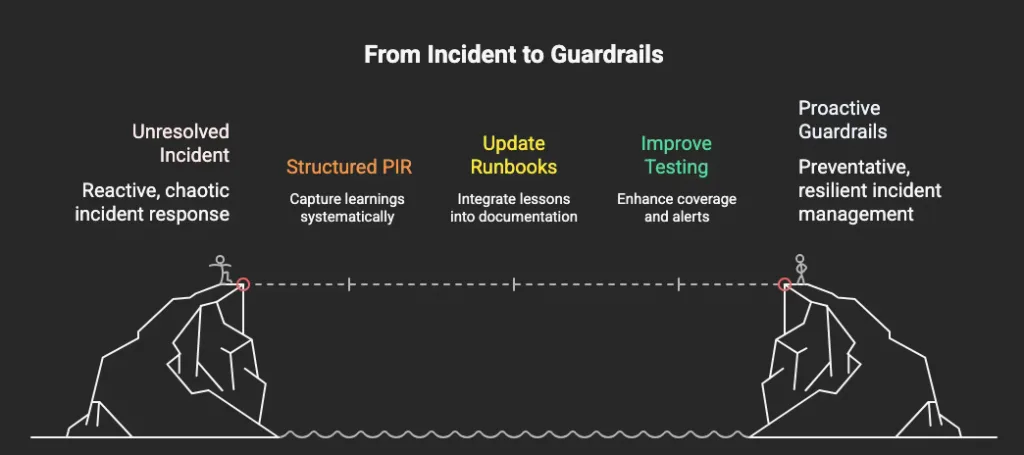
An orderly post-incident review (PIR) makes sure that learnings are documented upon and implemented:
- Timeline: Chronological events from detection to resolution
- Impact: It affects users, revenue, operations.
- Root cause(s): Technical, process, or human factors
- Corrective/Preventive Actions (CAPA): Measures to correct and avoid future occurrence.
- Owners and due dates: Accountability and follow-up
Aim: To convert the Learnings into Guardrails.
- Lessons learned, update runbooks.
- Improve test coverage and alert thresholds
- Perform chaos exercises and simulations to certify incident response preparedness.
Governance: Do Not Have P0 become the Default.
- Anti-patterns: Do not declare all things as P0; avoids alert desensitization and fatigue.
- Periodic calibration meetings: Discuss exemplar incidents as a way to bring team to common ground in terms of P0 vs P1.
- Dashboard for priority distribution: Track incident trends, priority allocations, and resolution times for continuous improvement
Downloadable Resources (Optional)
- P0 vs P1 decision tree: 1-page visual guide for rapid classification
- PIR template (doc): Post-incident review template.
- Paging matrix (sheet): Overview of role-based escalation and on-call rotation.
Conclusion
Knowing the difference between P0 vs P1 can allow managing the incident faster and more efficiently, minimize confusion in the work of the departments, and enhance communication between the stakeholders. Structured frameworks, thresholds, tie-breakers and post incident review allow the teams to consistently respond and learn out of the past incident.
What is P1 -P0?
Severity and impact is the difference that matters.
P0 (Priority 0): System outage, or system down, or service unavailable to all users, which is business critical. Requires 24/7 response.
P1 (Priority 1): there is a significant impact on major functionality, yet the system is partially unavailable. Response time is urgent and not at the same level as P0.
What is a P0 incident?
A severe failure in which the system or application becomes unavailable or degraded to the point that it affects all users or business operations critically is known as a P0 incident. This normally causes an all hands on deck until it has been addressed.
What does P0 vs P1 priority mean?
It is the categorization of the problems in terms of gravity:
P0 priority: This is the most critical, the top level, urgent problem to solve.
P1 priority: High priority but not total outage - urgent fix must be taken as part of SLA.
Q6. What about P0 vs P1 vs P2?
P0: system failure (all users affected).
P1: Critical bug (critical functionality damaged).
P2: Medium-level problem (has an impact on some users, but there are workarounds).
Is p0 highest priority
Yes, P0 is the highest priority level in standard software development and project management systems